


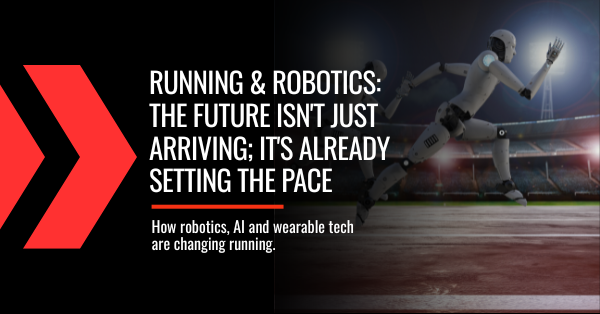
For centuries, running has been the purest test of human biology, pitting muscle and lung power against the clock. Today, the boundaries of endurance are rapidly expanding as bionic technology bridges the gap between biological limits and mechanical innovation. As prosthetics and wearable tech grow increasingly sophisticated, we are forced to ask: does the future of the sport belong to the runner, the machine, or a ground-breaking hybrid of both?
The Dawn of Mechanical Pace: The Beijing Robot Half Marathon
Imagine standing at the starting line with your heart pounding, right beside you is the hum of electric motors and the gleam of polished carbon fibre. Welcome to the Beijing Robot Half Marathon, a historic annual clash of flesh and steel held in Beijing’s high-tech E-Town.
On 19 April 2025, the inaugural 21.1-kilometre race kicked off from Nanhaizi Park to Tongming Lake. Human runners and humanoid robots started simultaneously but ran on separate, barrier-divided tracks. This first event was a brutal wake-up call for the machines; systems overheated, humanoids suffered dramatic falls, and only six out of twenty-one mechanical starters finished, with the winner finally home in a gruelling two hours and forty minutes.
Fast-forward to April 2026, and everything changed. Over one hundred fully upgraded humanoid robots lined up and demonstrated flawless agility and advanced thermal management. History was ultimately shattered by a humanoid robot named "Lightning," developed by tech giant Honor, which clocked an astonishing 50 minutes and 26 seconds. Lightning did not just win; it utterly obliterated the official human half-marathon world record of 57 minutes and 20 seconds!
While these machines are rewriting the record books, the very technology powering them is set to revolutionise human performance. The advanced thermal management systems engineered to keep robots cool under intense mechanical strain are paving the way for next-generation smart apparel that actively regulates a human athlete's core body temperature. Furthermore, the high-frequency predictive AI models used by robots to read topography and adjust their stride in milliseconds are being integrated into consumer wearables. These smart sensors analyse a runner’s real-time biomechanics, offering instant adjustments to stride length, cadence, and foot strike to maximize energy efficiency and prevent injuries. Finally, the lightweight, high-energy-return carbon composites developed for robotic limbs are directly inspiring the next evolution of super-shoes, promising humans unprecedented mechanical propulsion with every step.
The Technology Race
China may dominate the headlines with massive, multi-robot road races, but the relentless duel for bipedal supremacy is unfolding on the track. The true engineering battleground - teaching a machine to master human-like locomotion - is a fierce, ongoing clash between American academic grit and Chinese commercial ingenuity.
The 100-Metre Sprint Record - the starting blocks have already yielded historic milestones. In May 2022, the Oregon State University Dynamic Robotics Laboratory obliterated the track. Their bipedal machine, Cassie, rocketed into the record books, setting the official Guinness World Record for the fastest 100-metre dash by a bipedal robot. Launching from a dead stop, Cassie tore down the track in a blistering 24.73 seconds, staying upright the entire way.
The 5K Endurance Test - the American lab didn't just stop at sheer sprint speed; they built profound endurance into the machine. Before dominating the 100m, the OSU team taught Cassie how to handle true distance. The robot successfully navigated a full 5-kilometre outdoor course on a single battery charge. Blending asphalt, grass, and varied terrain, Cassie conquered the distance in just over 53 minutes.
Cross-pollination: Human biology and robotics
Running technology is shifting from simple metrics toward a futuristic cross-pollination of human biology and robotics. Today, video analysis platforms like Ochy and Movaia are dismantling complex biomechanics. By parsing standard smartphone footage, these tools track joint angles, center of mass (COM) stability, and stride symmetry.
Interestingly, this relies heavily on the exact computer vision algorithms and dynamic-balance frameworks pioneered by tech firms training humanoid robots like Figure 03 or Tesla Optimus. To make robots jog like humans, engineers mapped how biological bodies manage mid-air "flight phases," real-time terrain micro-corrections, and energy distribution. Running software has appropriated these exact robotic models to pinpoint exactly when a human runner's joint coordination deviates from an energy-efficient path, effectively giving everyday athletes access to lab-grade lab diagnostics.
By 2035, this convergence will entirely blur the line between runner and machine. Static post-run metrics will feel like ancient history. The advanced running landscape will likely revolve around integrated biomechanical ecosystems:
- Active Bio-Feedback Apparel: Fabrics woven with neural-network sensors will monitor muscle fatigue and joint strain in real time, making active micro-adjustments to a runner’s gait via targeted haptic pulses to prevent injuries mid-stride.
- Proactive Exoskeletal Wearables: Ultra-lightweight, reactive wearable exoskeletons - built heavily from the continuous advancement of humanoid actuators - will augment human force, allowing everyday runners to safely cross past their natural biological speed or structural thresholds.
- Autonomous Digital Twins: Your cloud-hosted, predictive digital twin will run thousands of virtual marathons before you ever pin on a race bib, dynamically calculating your exact carbohydrate oxidation rate, cardiovascular ceiling, and bone stress limits for any weather condition or terrain.
Ultimately, the intersection of robotics and human endurance is rewriting what it means to run. As we sprint toward 2030 and beyond, technology will no longer just count your miles — it will actively protect your joints, optimise your energy, and unlock your true biological potential. By adapting the same brilliant tech used to build humanoid runners, tomorrow's tools will serve as an invisible co-pilot for your stride. The future isn't just arriving; it's already setting the pace!
IRX 2026 is THE event for global brands, retailers, distributors and industry leaders
Join fellow industry professionals at The International Running Expo (IRX) 2026 - Europe’s only dedicated business event for the running sector. Returning to RAI Amsterdam on 4-5 November, #IRX2026 features 200+ global brands showcasing the technologies and products shaping the future of the sport. Secure early-bird rates today.